
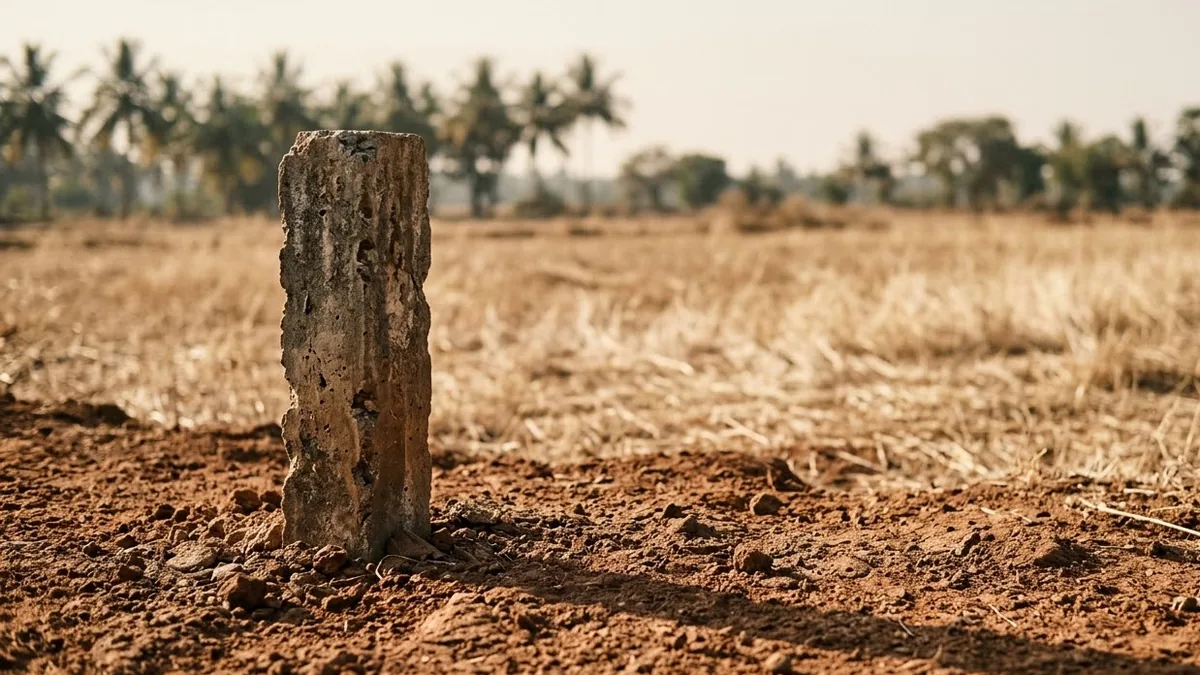
A farmhouse an hour outside Bangalore is a very different project from a house on a 30x40 site in the city — and most of the difference has nothing to do with architecture. It is land status, approvals, and the simple fact that everything you need has to travel further to reach the site.
Owners usually discover this in the wrong order: they buy the land first, design the house second, and only then find out what the plot will and won’t allow. Here is the sequence that avoids that.
Start With the Land’s Legal Status, Not the Design
This is the step that decides whether the rest of the project is straightforward or stuck.
Agricultural Land Needs Conversion Before You Build
Most land in the belts people like — Kanakapura Road, Doddaballapur, Nelamangala, Magadi Road, Hoskote, Devanahalli — is classified as agricultural. Building a residential structure on it legally requires DC conversion (converting the land to non-agricultural use) through the district administration. Without it, you may be able to put up a farm structure, but you cannot treat it as a sanctioned residential building, and financing or resale later becomes difficult.
Conversion takes time and paperwork. Start it before you finalise a design, not after.
Check the Title, Survey Number and Encumbrances
Ask for the RTC (pahani), mutation records, survey sketch and an encumbrance certificate covering a meaningful period. Confirm the survey number on paper matches the boundary actually being shown to you on the ground — on large rural parcels, these disagree more often than buyers expect. A lawyer’s opinion on title costs very little relative to the land.
Confirm Which Authority Sanctions Your Plan
Outside the BBMP and BDA limits, sanction usually comes from the gram panchayat, or from a planning authority if the land falls within one’s jurisdiction. The rules on permissible built-up area, setbacks and height differ from city norms, and they differ between authorities. Get this confirmed in writing before the drawings are finalised — a design drawn to city assumptions can fail panchayat setbacks entirely.
Budget for the Site, Not Just the Building
Construction rates for a farmhouse are broadly similar to a city build — roughly ₹1,800 to ₹3,000 per sq ft for a standard-to-premium finish. What changes the total is everything around the structure.
Distance Adds a Real Premium
Every load of cement, steel, sand and blocks travels further, and returns are harder. Labour often has to be housed on site. Skilled trades — a good electrician, a tile mason, a carpenter — charge more to travel out and may only come in blocks, which stretches timelines. Depending on distance and access, expect 10–20% on top of the equivalent city cost for the same specification.
Site Infrastructure Is Its Own Line Item
On a city plot, water, power and drainage arrive at the boundary. On rural land, you build them:
- Water — borewell, sump and pumping. Yield varies dramatically by locality; test before you plan a garden or pool.
- Power — a fresh service connection, and often a transformer contribution if the nearest line is far. Many owners add solar for exactly this reason.
- Sewage — no municipal line, so a septic tank or a small STP.
- Approach road — the stretch from the main road to your gate is frequently yours to build and maintain.
- Compound wall and gate — on a large parcel this is a serious cost, not a finishing touch, and it usually comes first for security reasons.
Plan for the Building Being Empty
A farmhouse used on weekends needs to survive being unoccupied on weekdays. That pushes you towards durable, low-maintenance choices: better waterproofing, weather-resistant external finishes, secure joinery, a caretaker’s room, and a way to monitor water and power remotely. Spending here is cheaper than repairing neglect later.
Design Choices That Actually Suit a Rural Plot
Large plots invite people to spread the house out, which is often the right instinct and occasionally an expensive one.
Single storey with generous verandahs works well when land is plentiful — it avoids staircases, keeps the plan open, and the covered outdoor space is what people actually use a farmhouse for.
Orient for wind and shade, not for the view alone. Karnataka summers are strong and the site is exposed in ways a city plot is not. Cross-ventilation, deep overhangs and shaded outdoor seating do more for comfort than air conditioning added afterwards.
Keep the servicing simple. Long plumbing runs, scattered wet areas and multiple isolated structures multiply maintenance on a property nobody visits daily. Group the wet areas. Keep the plant room accessible.
Build in phases if the budget is stretched. Get the main structure, water, power and boundary right first. Landscaping, pool, guest block and outbuildings can follow without rework — provided the services were planned for them from day one.
What to Ask a Farmhouse Builder Before Signing
- Have they completed farmhouse projects outside city limits, and can you visit one?
- Who handles the panchayat or planning authority approval — you or them?
- How is material logistics priced, and who carries the cost of a wasted trip?
- What is the plan for water and power during construction, before connections exist?
- Is site security and labour accommodation included in the quote?
- What does the maintenance handover look like for a property that stays empty?
Conclusion
A farmhouse rewards planning far more than a city build does, because the site gives you less for free. Get the land status and sanctioning authority settled first, budget honestly for distance and infrastructure, and design for a building that spends most of its week alone. Do those three things and the construction itself is the straightforward part.
If you are planning a farmhouse around Bangalore and want the land, approvals and build handled as one project rather than three separate problems, we’re happy to walk your site and give you an honest read before you commit to anything.