
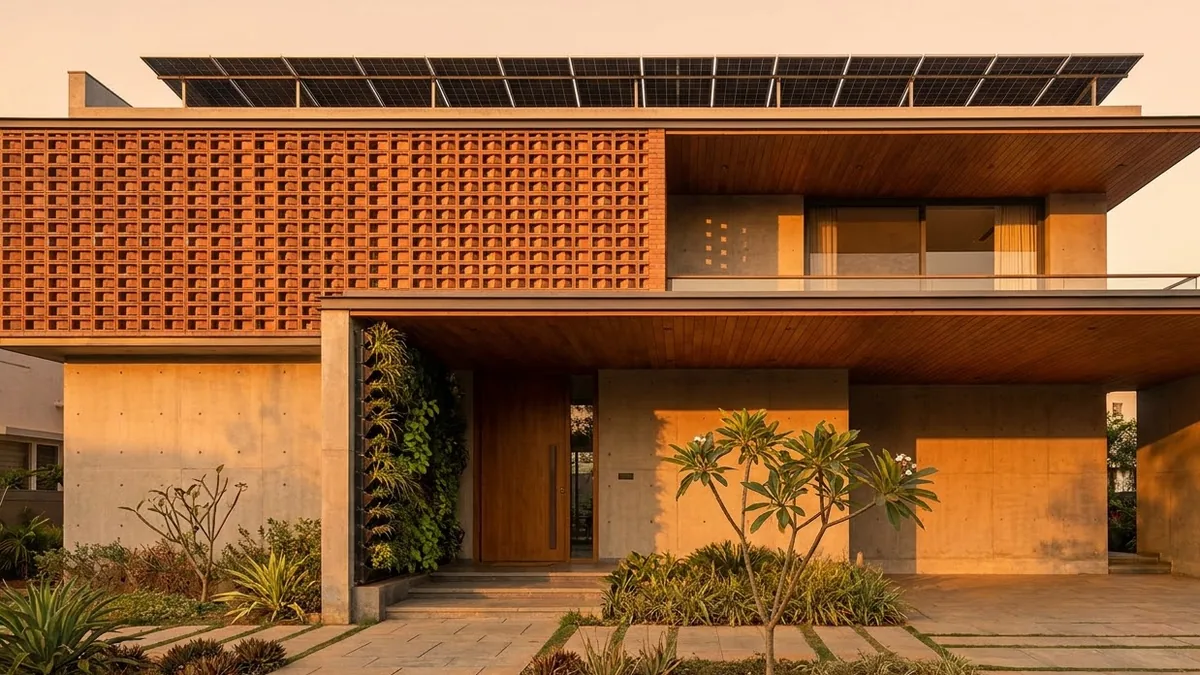
Most “trend” lists are really taste lists — a finish that will look dated in three years. The changes worth paying attention to in Bangalore right now are different: they are responses to power costs, water availability, longer working-from-home hours, and a climate that has become less predictable.
Here is what homeowners are actually choosing in 2026, and why each one holds up beyond the year.
Climate-First Planning Instead of Retrofitted Comfort
The clearest shift is that orientation and ventilation are being treated as design decisions rather than afterthoughts.
Cross-ventilation designed in from the plan stage. Openings placed on opposite walls, stairwells used as warm-air chimneys, and courtyards reintroduced on narrow plots. Bangalore’s climate rewards this more than almost any Indian city — a well-ventilated house here genuinely needs less cooling.
Deeper overhangs and shaded openings. Chajjas, pergolas and recessed windows are back, because they solve heat gain and monsoon splash at the same time. They also age far better than a flat façade with no protection.
Light without heat. North light where possible, smaller openings on the west, and lighter external colours. These cost nothing at the design stage and everything to correct later.
Solar and Rainwater as Standard, Not Upgrades
Rooftop solar has moved from an enthusiast choice to a default calculation. For an independent house with usable roof area, the payback period now sits well inside the time most owners plan to stay, and the roof is far cheaper to prepare during construction than after.
Rainwater harvesting is mandatory for many plot sizes under BBMP rules, but the practical trend is people doing more than the minimum — sizing the recharge properly, connecting the whole roof, and treating it as borewell insurance rather than a compliance box.
The related move is planning the services before the slab: conduit routes for solar, provision for an EV charging point in the parking, and space for a water treatment unit. Each is trivial to accommodate now and disruptive to add later.
Rooms That Can Change Their Mind
Working from home stopped being temporary, and floor plans have adjusted.
A real study, not a corner of a bedroom. Even a small dedicated room with a door and a proper electrical point is now high on most briefs.
Flexible ground-floor rooms. A room that works as a guest bedroom, a study or an elderly parent’s room — with an attached bathroom and no stairs — is one of the most requested items in Bangalore right now, and one of the easiest to plan for.
Utility spaces taken seriously. A proper utility area, a drying space that isn’t the balcony everyone sees, and storage designed in rather than bought later.
Materials Chosen for How They Age
The visible material trend is restraint. Fewer finishes, used well, instead of many finishes competing.
Exposed and textured surfaces — fair-face concrete, textured plaster, natural stone — used in limited areas where they carry the design.
Warm neutrals with wood tones, replacing the very cool grey palettes of the last few years.
Durable external finishes chosen specifically for Bangalore’s monsoon humidity, because a façade that streaks and grows algae in two years undoes an otherwise good build.
Larger-format tiles and fewer joints, which look calmer and are easier to keep clean.
Building Practices Quietly Improving
- Better waterproofing detailing, especially at terraces, parapets and wet-area junctions, which is where most long-term complaints originate.
- Concrete-quality control — cube testing and proper curing being asked for by owners, not just offered by builders.
- 3D design and walkthroughs before approval, so layout decisions are made when they are still free to change.
- Phased construction — completing the structure and essential services first, and finishing the second floor or landscaping later, without rework.
Trends Worth Ignoring
Not everything popular is worth your money.
Very large glazed façades on west-facing elevations look striking and turn rooms into ovens. Heavy decorative ceilings in every room date quickly and eat height. Elaborate landscaping installed before the family has lived through one monsoon usually gets redone. And any material chosen purely because it photographs well deserves a second look at how it behaves in year five.
Conclusion
The construction ideas worth adopting in Bangalore in 2026 are the ones that respond to how the city actually is — humid monsoons, strong summers, uncertain water, expensive power — and to how people now use their homes. Get the orientation, ventilation, services and waterproofing right, keep the materials few and durable, and the house will still feel current long after this year’s finishes stop being fashionable.
Most of these decisions are made during turnkey construction, long before the finishes are chosen. If you’re planning a build and want to see them worked into an actual plan for your plot, we’re happy to sit down and go through it with you.